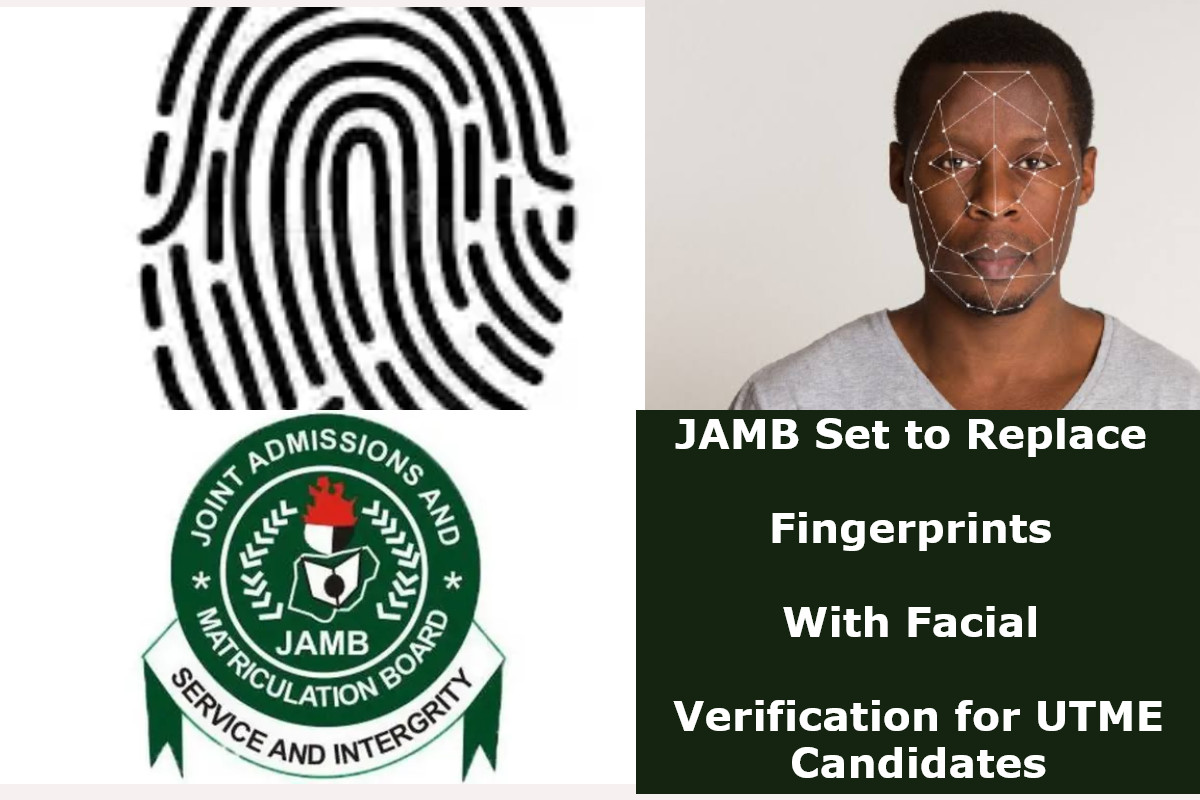
The Joint Admissions and Matriculation Board (JAMB) is preparing to change the way candidates are verified during the Unified Tertiary Matriculation Examination (UTME), with facial recognition expected to gradually replace fingerprint authentication.
The Board said it is introducing Facial Biometric Verification (FBV) as part of efforts to strengthen the identity checks used during the examination and tackle impersonation and other forms of examination malpractice.
The proposed system will be implemented in collaboration with the National Identity Management Commission (NIMC), allowing candidates’ live facial images to be checked against their identity records.
However, JAMB has made it clear that the change will not happen overnight. The existing fingerprint system will remain in use during the transition, while facial verification is introduced alongside it
Read Also: How to Locate JAMB Office in Benin City
Why JAMB Is Moving Away From Fingerprints
One of the major reasons behind the proposed change is the recurring difficulty some candidates experience when their fingerprints cannot be properly captured or recognized.
JAMB has used fingerprint authentication as part of its biometric checks for years. Its existing examination procedures require candidates to provide fingerprints for authentication.
But fingerprint verification can sometimes fail because of the condition of a candidate’s fingers or problems with the scanning process.
JAMB has previously made provisions for candidates who experience difficulty with fingerprint capture, showing that biometric verification failures have been an issue in the examination process.
The Board now believes facial verification can provide a more reliable alternative for confirming that the person appearing for the examination is the same person registered for it.
Facial Verification Will Help Fight UTME Impersonation
Beyond technical problems with fingerprints, examination security is at the centre of JAMB’s decision.
The Board wants to make it more difficult for one person to sit for the UTME on behalf of another candidate.
Under the proposed arrangement, a camera at the Computer-Based Test (CBT) centre will capture the candidate’s face. The image will then be transmitted through a dedicated application to NIMC for identity matching.
A confirmation code will be generated after the verification process, indicating whether the candidate’s identity has been successfully confirmed.
This means the verification will be based on the candidate’s face rather than relying entirely on a physical fingerprint scan.
There Is Also a Hygiene Benefit
JAMB has identified another advantage of the proposed system: candidates will not need to touch a fingerprint scanner.
Unlike fingerprint authentication, facial verification is contactless. Candidates simply have their faces captured by a camera during the verification process.
This could reduce physical contact with shared biometric equipment at busy examination centres, where large numbers of candidates may use the same devices.
While examination security remains the primary reason for the change, JAMB considers the reduced physical contact an additional benefit of facial verification.
JAMB Says Facial Checks Can Be Faster
Speed is another factor behind the planned move.
According to JAMB, facial verification can be completed in less than a second when the conditions are suitable.
The Board also said the technology can work with standard cameras found on devices such as smartphones, tablets and computers, meaning the system does not necessarily depend on specialised facial-scanning equipment.
For candidates, faster verification could mean less time spent dealing with biometric authentication before entering the examination hall.
Fingerprints Will Not Be Removed Immediately
Despite the planned change, candidates should not assume that fingerprint verification has already been discontinued.
JAMB’s current 2026 examination materials still provide for fingerprint capture and biometric authentication.
The Board plans to maintain the existing 10-fingerprint system in the short term while facial verification is introduced.
Over the next two to three years, however, JAMB expects facial verification to become the main method and eventually replace fingerprint authentication and One-Time Passwords (OTPs).
This means candidates will likely see a gradual transition rather than an immediate switch from one system to another.
What the Change Means for Future UTME Candidates
For future UTME candidates, the proposed system could make identity verification less dependent on physical contact and reduce some of the problems associated with failed fingerprint scans.
It could also strengthen JAMB’s ability to confirm candidates’ identities before and during the examination.
The partnership with NIMC is particularly important because the facial images will be matched against identity information held within the national identification system.
JAMB’s objective is therefore not simply to introduce a new type of biometric technology. The wider aim is to make it harder for impersonators to take examinations for registered candidates while making the verification process more convenient.
For now, candidates should continue to follow the official instructions issued by JAMB for their particular UTME registration and examination cycle, as fingerprint authentication remains part of the current system.
Get Real-time Edo State News, Job Alerts and Opportunities
Join our WhatsApp Channel for breaking news, job updates, scholarships, and opportunities in Edo State.
Join Our WhatsApp Channel →