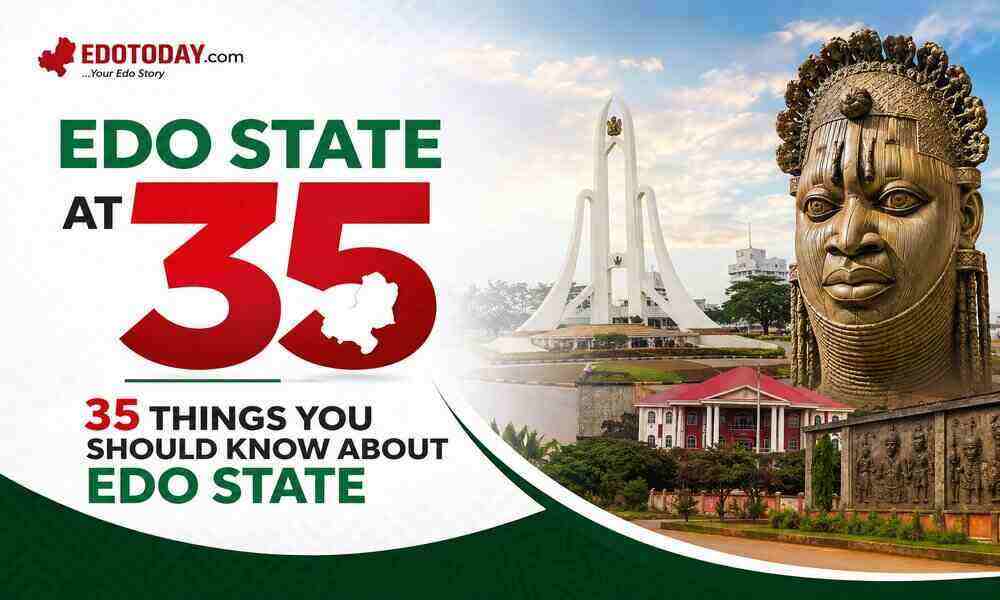
Edo State is 35 years old.
On August 27, 1991, the old Bendel State was split into Edo and Delta states. Thirty-five years later, Edo has grown from a newly created state into one of the better-known states in southern Nigeria, with Benin City at its centre and communities spread across Edo South, Edo Central and Edo North.
But 35 years is also a good time to look beyond the usual birthday messages.
How many people have actually governed Edo since 1991? What happened during the years of military rule? Who were the first elected governors? How did Benin City change? What happened to education, roads and agriculture? And what is the government of Governor Monday Okpebholo doing now?
There is quite a lot to talk about.
Here are 35 things worth knowing about Edo State at 35.
1. Edo State was created on August 27, 1991
Edo State was created on August 27, 1991, when the Federal Military Government divided the old Bendel State into Edo and Delta states.
John Ewerekumoh Yeri became the first military governor of the newly created Edo State.
So when Edo celebrates its 35th anniversary in 2026, it is marking 35 years since the state took its present form.
The history of the people, however, goes much further back than 1991.
2. Edo was once part of Bendel State
Before Edo became a state of its own, it was part of Bendel State.
Bendel was itself created in 1967 from the former Mid-Western Region and covered areas that eventually became Edo and Delta states.
That is why older Edo residents will sometimes refer to the years before 1991 when discussing the state’s political and economic history.
The split changed the political map, but it did not erase the connections between the people on both sides of the old Bendel boundary.
3. Eleven people have governed Edo since 1991
This is one of the facts that often gets left out when people talk about Edo at 35.
Eleven people have governed or administered Edo State since its creation.
They are:
- John Ewerekumoh Yeri
- John Odigie Oyegun
- Mohammed Abul-Salam Onuka
- Bassey Asuquo
- Baba Adamu Iyam
- Anthony Onyearugbulem
- Lucky Igbinedion
- Oserheimen Osunbor
- Adams Oshiomhole
- Godwin Obaseki
- Monday Okpebholo
The first six were military governors or administrators who served before the return to uninterrupted civilian rule in 1999. The remaining five have been elected executive governors.
Historical records place Yeri in office when Edo was created, followed by Oyegun, four military administrators, and then the elected governments beginning with Lucky Igbinedion in 1999.
Read Also : First Five Military Governors Who Ruled Edo State From 1991 to 1998
4. John Odigie Oyegun was Edo’s first elected governor
John Odigie Oyegun holds a special place in Edo’s political history.
He became the state’s first civilian governor after winning the 1991 election under the Social Democratic Party.
His time in office was short. He left office in November 1993 after the military takeover that ended the civilian government.
Years later, Oyegun would become a major figure in national politics and the first national chairman of the All Progressives Congress.
5. Edo returned to military rule after Oyegun
After Oyegun left office, Edo went through another period of military administration.
Mohammed Abul-Salam Onuka, Bassey Asuquo, Baba Adamu Iyam and Anthony Onyearugbulem successively administered the state between 1993 and 1999.
This period matters because it means Edo’s first attempt at civilian government did not continue uninterrupted.
The return to civilian rule came in 1999.
6. Lucky Igbinedion began the current era of elected governments
Lucky Igbinedion became governor on May 29, 1999.
He won a second term in 2003 and remained in office until May 2007.
His eight years covered the first two terms of Nigeria’s return to democratic rule and marked the beginning of the long period of civilian administrations that Edo has had since then.
7. Oserheimen Osunbor’s time as governor lasted less than two years
Professor Oserheimen Osunbor succeeded Igbinedion after the 2007 election.
His time in office was cut short after the election result was overturned by the courts.
Adams Oshiomhole was declared the winner of the election and took office in November 2008.
That episode remains one of the major political events in Edo’s post-1999 history.
8. Adams Oshiomhole spent eight years in office
Adams Oshiomhole governed Edo from 2008 to 2016.
He won a second term in 2012, giving him eight years in office.
His administration became particularly associated with road construction, urban projects, school infrastructure and the renovation of parts of Benin City.
Whether people agree with the assessment of his government or not, the Oshiomhole years remain one of the most discussed periods in Edo’s recent political history.
9. Godwin Obaseki succeeded Oshiomhole
Godwin Obaseki became governor in November 2016.
He initially contested under the APC and won a second term in 2020, this time under the Peoples Democratic Party after his political disagreement with the APC.
His eight years in office covered major reforms in education, technology, healthcare and public administration.
The Edo State Basic Education Sector Transformation programme, commonly known as EdoBEST, became one of the most visible policies associated with his government.
10. Monday Okpebholo is Edo’s current governor
As Edo marks 35 years, the state is being governed by Senator Monday Okpebholo.
Okpebholo was elected in September 2024 and took office on November 12, 2024.
His administration came in with a five-point agenda covering security, infrastructure, healthcare, food sufficiency and education, with agriculture also receiving major attention.
The governor’s administration has since focused heavily on roads, schools, healthcare, security, agriculture and public transportation.
11. Dennis Idahosa is the current deputy governor
The other half of the current executive team is Deputy Governor Dennis Idahosa.
Idahosa was elected alongside Monday Okpebholo in 2024.
Together, they took over from Godwin Obaseki and Omobayo Godwins.
The current administration therefore represents the fifth elected civilian government since the return to democracy in 1999.
12. Edo has had five elected governors since 1999
If you count only elected civilian governors since Nigeria returned to democracy, the list is much shorter:
- Lucky Igbinedion — 1999–2007
- Oserheimen Osunbor — 2007–2008
- Adams Oshiomhole — 2008–2016
- Godwin Obaseki — 2016–2024
- Monday Okpebholo — 2024–present
That means Edo has had five elected executive governors in the 27 years between 1999 and 2026.
The wider figure is 11 when the military administrators are included.
13. Benin City is the capital of Edo State
Benin City is the capital and biggest urban centre in Edo.
It is where the state government sits, but its importance goes well beyond government offices.
The city is a major centre for trading, education, transport, healthcare, entertainment and business.
For many people traveling between parts of southern Nigeria, Benin City is also an important stop along the way.
14. Edo has 18 local government areas
Edo State has 18 Local Government Areas:
- Akoko Edo
- Egor
- Esan Central
- Esan North-East
- Esan South-East
- Esan West
- Etsako Central
- Etsako East
- Etsako West
- Igueben
- Ikpoba-Okha
- Oredo
- Orhionmwon
- Ovia North-East
- Ovia South-West
- Owan East
- Owan West
- Uhunmwode
These LGAs spread across the three senatorial districts.
Read Also: Complete List of Local Government Areas in Edo State
15. Edo has three senatorial districts
The state is divided into:
Edo South,
Edo Central, and
Edo North.
Edo South includes Benin City and surrounding areas.
Edo Central is largely associated with the Esan communities.
Edo North covers areas including Auchi, Etsako, Owan and Akoko Edo.
The three districts have their own political, cultural and economic characteristics.
16. Edo is much bigger than Benin City
Because Benin City is by far the most prominent city in the state, it can sometimes give outsiders the impression that Edo is simply another name for Benin.
It isn’t.
There are towns such as Ekpoma, Uromi, Irrua, Auchi, Igarra, Agenebode, Afuze, Sabongida-Ora and Ubiaja, among many others.
Each has its own history and role in the state’s economy.
This is important when discussing development in Edo because a road or project in Benin City does not necessarily solve the problems faced by somebody in Edo North or Edo Central.
17. The Benin Kingdom is at the heart of Edo’s history
The history of Edo cannot be separated from the history of the ancient Benin Kingdom.
Benin developed into a powerful kingdom with a sophisticated political structure, organized urban life and an artistic tradition that became known around the world.
The modern Edo State came into existence in 1991, but the history that gives the state much of its identity is centuries older.
18. The Oba of Benin remains an important traditional institution
The Oba of Benin is one of Nigeria’s best-known traditional rulers.
The Benin monarchy has survived changes in political systems, colonial rule, military government and democratic government.
For many Edo people, the institution represents more than a traditional title. It is closely tied to history, customs and identity.
19. The Benin Bronzes made Edo famous around the world
The Benin Bronzes are among the most recognised African artworks in the world.
They include plaques, sculptures and other objects produced by artists of the Benin Kingdom.
Many were taken from Benin during the British invasion of 1897 and later ended up in museums and private collections outside Nigeria.
Their ownership and return have remained an important issue between Nigeria and institutions abroad.
For Edo, the conversation is not simply about old artworks. It is also about history, ownership and what happens when cultural treasures are removed from the communities that produced them.
20. The Benin earthworks are another part of the state’s history
The ancient Benin earthworks, often referred to as the Benin Moat, were enormous earth structures surrounding the old city and its settlements.
They are evidence of the scale of organisation and labour that existed in the Benin Kingdom before modern construction machinery.
The earthworks are one of the historical features that make Benin’s past different from the usual stories told about Nigerian cities.
21. Edo has a strong Esan identity
Travel from Benin City towards Edo Central and the cultural setting changes.
The Esan people are spread across communities including Ekpoma, Irrua, Uromi, Ubiaja and surrounding areas.
Edo Central has produced academics, politicians, businesspeople, professionals and other prominent Nigerians.
The region is also home to Ambrose Alli University in Ekpoma.
22. Edo North has its own history and identity
Edo North is not simply an extension of Benin City.
The area is home to different communities, including Afemai, Owan and Akoko Edo people.
Auchi is one of the biggest towns in the area, while places such as Igarra, Agenebode and Afuze are important to their respective communities.
Agriculture, trading, education and local businesses are important parts of life across the district.
23. Edo is home to several important tertiary institutions
Edo has a long history of higher education.
Among its institutions are University of Benin, Ambrose Alli University, Auchi Polytechnic, Benson Idahosa University, Igbinedion University, and several other universities, polytechnics, colleges and specialised institutions.
The education sector has also helped create secondary businesses around student accommodation, food, transport, printing, fashion and retail.
24. Ekpoma became known nationally because of its university
Ambrose Alli University has been part of Ekpoma’s identity for decades.
The university attracts students and staff from different parts of Nigeria and has helped turn the town into a major educational centre.
Its influence extends beyond the campus, affecting businesses and landlords across the town.
The institution is also one of the major reasons Ekpoma is so well known outside Edo State.
25. Agriculture is still important to Edo
Edo is not an oil-producing state in the way states such as Delta, Rivers or Bayelsa are, so agriculture remains particularly important.
The state has large areas suitable for farming and produces crops including cassava, maize, plantain, banana, oil palm, rubber and other agricultural products.
There is also room for much more processing.
Instead of sending raw agricultural products outside the state, Edo can make more money from processing, packaging and manufacturing them locally.
26. Rubber and oil palm have long been part of Edo’s economy
Rubber and oil palm have been important parts of Edo State’s agricultural economy for decades. The state’s climate and large areas of fertile land have made it suitable for both large plantations and smaller farms.
Some of the better-known agricultural companies operating in the state include Okomu Rubber Company in Ovia South-West and Presco Plc, which has large oil-palm and rubber operations around Obaretin.
Edo has also had numerous privately owned rubber plantations, particularly around Ovia, Uhunmwode, Owan and parts of Edo Central.
But the real value of these crops goes beyond farming. Rubber can be processed into products used for tyres, footwear and industrial materials, while oil palm produces palm oil, palm kernel oil and other products used in food, cosmetics and manufacturing.
For Edo, the opportunity is not just to produce more rubber and palm fruit but to process more of them within the state, creating jobs and businesses around agriculture instead of sending out mostly raw produce.
Read Also: List of Rubber and Oil Palm Companies in Edo State: Locations and Operations
27. Edo’s roads have always been a major political issue
Mention politics in Edo and roads will eventually enter the conversation.
Every administration has had to deal with the condition of roads in Benin City and across the state’s rural communities.
The current Okpebholo administration has also put road construction high on its agenda.
Its 2026 budget includes allocations for road and bridge construction and rehabilitation across Edo South, Edo Central and Edo North. Projects listed include the Ekpoma-Uromi-Ubiaja Road and several roads across the northern part of the state.
28. Benin City has been dealing with traffic and drainage problems
As Benin City has expanded, traffic, flooding and drainage have become bigger concerns.
The current government has included flood-control works, drainage and road reconstruction in its 2026 plans.
For example, the 2026 Citizens Budget contains an allocation of more than ₦27.7 billion for flood control works and reconstruction of some affected roads in the GRA area of Benin City.
Whether these projects deliver the desired results will be something residents will judge for themselves.
29. The Ramat Park flyover is one of the current government’s major projects
The Okpebholo administration has started work on a flyover at Ramat Park in Benin City.
The project is intended to address traffic congestion around one of the city’s busy areas.
It is part of a broader road and transport programme that has included road construction and rehabilitation in Benin City and other parts of the state.
30. The current government has put money into education
Education is another major part of the present administration’s programme.
The government has announced renovation and reconstruction work in schools, including plans involving secondary schools across the state.
The 2026 Citizens Budget, for example, provides ₦2.781 billion for the renovation of 131 secondary schools across Edo State.
The state has also continued to deal with the larger question of what happens to teachers, school facilities and tertiary institutions.
31. Edo’s health sector remains a major issue
Healthcare has been another priority of the Okpebholo administration.
Its 2025 budget allocated ₦63.9 billion to health, with an additional ₦1.8 billion for the health insurance scheme. The government also announced interventions involving primary healthcare centres, medical equipment and maternal healthcare.
In 2026, the state budget includes funding for medical equipment for a 100-bed hospital in Uwessan.
These are the kinds of projects that matter to residents because healthcare is one area where people feel the effect of government directly.
32. Edo is trying to get more out of agriculture
The current government has made food production one of its major priorities.
The 2026 budget includes funding for agro-processing zones in Iguobazuwa, Irrua and Auchi, covering the state’s three senatorial districts.
That is an important direction for Edo.
A farmer who grows cassava, maize, oil palm or another crop should ideally have access to processing, storage and markets nearby. Otherwise, much of the value leaves the community.
33. Technology has become part of Edo’s government story
Edo’s development story is no longer only about roads and physical buildings.
The previous administration invested heavily in digital government and education technology, while the state has continued to pursue technology-related projects.
EdoBEST, digital services and internet connectivity helped bring technology further into the state’s public-sector conversation.
For young people, this matters because the job market they are entering is very different from the one their parents knew.
34. Edo still has serious problems to solve
Thirty-five years is long enough to celebrate achievements, but it is also long enough to ask uncomfortable questions.
Why are some communities still struggling with bad roads?
Why do young people continue to leave the state in search of opportunities?
Why do some public schools and health centres still need major attention?
How can Edo attract more industries that employ people rather than relying heavily on trading and government jobs?
How can Benin City grow without becoming harder to live in?
These questions should be part of any honest conversation about Edo at 35.
35. At 35, Edo is still writing its story
Edo’s 35 years have included military rule, elections, court battles, political defections, changes of government, road projects, education reforms, cultural debates and plenty of arguments over whether one administration did better than another.
That is politics.
But outside government offices, Edo is simply home to millions of people trying to live their lives.
A farmer in Owan has different concerns from a student in Ekpoma. A trader in Oba Market has different concerns from a civil servant in Benin City. A business owner in Auchi may be thinking about electricity and transport, while a family in a rural community may be more concerned about the road leading to the nearest hospital.
That is the real Edo.
And that is why the state’s 35th anniversary is worth more than a few congratulatory messages.
Edo has a history that predates Nigeria. It has a modern political history that is now 35 years old. It has had 11 governors and administrators since 1991, five elected governors since 1999, and a new administration led by Governor Monday Okpebholo since 2024.
The state has changed considerably since 1991.
Benin City has changed. The roads have changed. The schools have changed. Politics has changed. The economy has changed.
But there are still some familiar problems.
At 35, Edo therefore has plenty to celebrate and plenty of work left to do.
Frequently Asked Questions About Edo State at 35
When was Edo State created?
Edo State was created on August 27, 1991, after the former Bendel State was divided into Edo and Delta states.
How old is Edo State in 2026?
Edo State is 35 years old in 2026. The state’s 35th anniversary is August 27, 2026.
How many governors has Edo State had since 1991?
Edo has had 11 governors or military administrators since 1991, including John Yeri, John Oyegun, four subsequent military administrators, Lucky Igbinedion, Oserheimen Osunbor, Adams Oshiomhole, Godwin Obaseki and Monday Okpebholo.
How many elected governors has Edo had since 1999?
Edo has had five elected executive governors since 1999: Lucky Igbinedion, Oserheimen Osunbor, Adams Oshiomhole, Godwin Obaseki and Monday Okpebholo.
Who is the current governor of Edo State?
Senator Monday Okpebholo is the current governor of Edo State. He took office on November 12, 2024.
Who is the deputy governor of Edo State?
Dennis Idahosa is the current deputy governor.
How many local government areas are in Edo State?
Edo State has 18 local government areas.
What is the capital of Edo State?
Benin City is the capital of Edo State.
What is Edo State known for?
Edo is particularly known for the history of the Benin Kingdom, Benin art and bronzes, the Oba of Benin, its cultural traditions, agriculture, educational institutions and Benin City.
What are the three senatorial districts in Edo?
They are Edo South, Edo Central and Edo North.
What are some major towns in Edo State?
Apart from Benin City, major towns and urban centres include Ekpoma, Uromi, Irrua, Auchi, Igarra, Agenebode, Afuze, Ubiaja and Sabongida-Ora.
What is Edo State’s biggest strength?
There is no single answer. Edo’s history, people, location, agricultural land, educational institutions, cultural assets and commercial centre in Benin City all give the state advantages.
The bigger question is how effectively those advantages are converted into jobs, businesses and better living conditions for residents.
Get Real-time Edo State News, Job Alerts and Opportunities
Join our WhatsApp Channel for breaking news, job updates, scholarships, and opportunities in Edo State.
Join Our WhatsApp Channel →