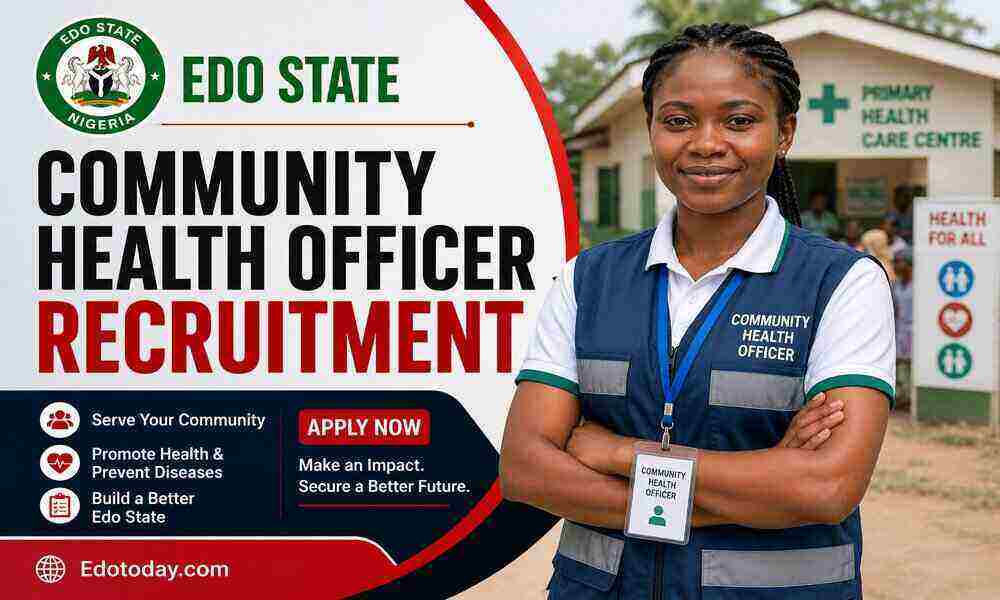
The Community Health Officer (CHO) is one of the health professionals working at the primary healthcare level in Edo State. Unlike jobs that are mainly based in government offices, a CHO works directly with patients, families and communities, often serving as one of the first health workers residents meet when they visit a Primary Health Care Centre (PHC).
For people searching for Edo State Community Health Officer recruitment 2026, it is useful to look beyond the application form. The job itself involves community-based healthcare, health education, disease prevention, maternal and child health services, referrals and follow-up of patients.
The Edo State Primary Health Care Development Agency (EDSPHCDA) coordinates primary healthcare services across the state and is involved in the recruitment, training and deployment of health workers to PHCs. Community Health Officers are among the frontline health workers operating within this system.
What is a Community Health Officer?
A Community Health Officer is a trained health professional who provides basic healthcare services and health education at the community and primary healthcare level.
The work is largely focused on preventing illness, identifying health problems early and making sure people receive appropriate care or are referred to a higher-level health facility when necessary.
In Edo State, CHOs can work in government-owned PHCs serving urban, semi-urban and rural communities.
The job can involve both facility-based work and community outreach. A CHO may attend to patients at a PHC in the morning and later participate in an outreach programme within surrounding communities.
The EDSPHCDA says its primary healthcare activities include general consultations, immunisation, antenatal care, family planning, maternal and child health services, disease surveillance, health promotion and referral services.
What does a Community Health Officer do in Edo State?
The exact duties depend on the facility and assignment, but a CHO’s work can include:
- Attending to patients at a Primary Health Care Centre.
- Taking patients’ basic health history and carrying out preliminary assessments.
- Providing health education to individuals and families.
- Supporting immunisation activities.
- Supporting maternal and child health programmes.
- Assisting with family planning services.
- Monitoring patients and following up on cases.
- Identifying health conditions that require referral.
- Referring patients to secondary or tertiary hospitals when necessary.
- Participating in community health outreach programmes.
- Supporting disease prevention and surveillance activities.
- Keeping patient and service records.
- Participating in health campaigns organised by the government and health partners.
- Working with nurses, midwives, doctors, CHEWs and other health workers.
- Mobilising members of the community for health programmes.
Community outreach is an important side of the job. The state health agency says its community programmes are designed to take services closer to residents, including immunisation, maternal and child health services, family planning, screening and health education.
Where do Community Health Officers work?
Most people who secure government CHO positions in Edo State should expect to work within the primary healthcare system, rather than being posted to a teaching hospital.
The state has an extensive network of PHCs serving communities across its 18 Local Government Areas.
The EDSPHCDA has previously conducted frontline health-worker training involving CHOs across all 18 LGAs, showing the role these workers play in the state’s grassroots healthcare system.
A CHO can therefore be assigned to a PHC serving a particular community, with the exact facility determined by the government’s staffing and deployment needs.
Edo State LGAs where CHOs can be posted
The 18 Local Government Areas in Edo State are:
- Akoko-Edo
- Egor
- Esan Central
- Esan North-East
- Esan South-East
- Esan West
- Etsako Central
- Etsako East
- Etsako West
- Igueben
- Ikpoba-Okha
- Oredo
- Ovia North-East
- Ovia South-West
- Owan East
- Owan West
- Uhunmwonde
- Orhionmwon
A successful applicant should not assume that recruitment automatically means posting to Benin City.
The purpose of the primary healthcare workforce is to make health services available at community level. For that reason, recruitment and deployment can place workers in LGAs and communities where there are staffing needs.
Can a CHO be posted to a rural LGA?
Yes.
A government health worker may be posted to a rural or semi-urban PHC depending on the state’s staffing requirements.
This is especially relevant because some communities have fewer health professionals than the major urban centres. The state has been working to strengthen PHC staffing and services across the 18 LGAs.
Applicants should therefore be prepared to accept deployment outside their immediate town if they are offered a government appointment.
What happens after Community Health Officer recruitment?
- Getting selected is not necessarily the final step.
- After recruitment, successful candidates may go through documentation, verification, orientation or other onboarding procedures before receiving their deployment instructions.
- The worker is then assigned to a health facility or service location.
- For a CHO, this will generally be within the primary healthcare system.
- At the facility, the officer becomes part of the team responsible for providing basic healthcare and supporting public health programmes in the surrounding community.
- Depending on the assignment, the CHO may spend some days mainly attending to patients at the PHC and other days participating in outreach activities.
The Edo State PHC agency also conducts training and capacity-building programmes for frontline health workers. In March 2025, for example, the agency worked with federal and development partners to train 900 frontline health workers across the state’s 18 LGAs, including Community Health Officers.
This shows that training does not necessarily stop after obtaining the qualification. Government health workers can be exposed to additional training as new health programmes and clinical priorities are introduced.
How much does a Community Health Officer earn in Edo State?
Salary is one of the questions applicants usually ask before considering a government health job.
The exact salary of a CHO depends on the grade level, qualification, step, appointment type and the applicable government salary structure.
Edo State’s PHC agency reported in July 2026 that the Consolidated Health Salary Structure (CONHESS) was being implemented for health workers in the state.
This means it would be misleading to give applicants one fixed figure as the guaranteed monthly salary of every newly recruited CHO.
The actual appointment letter and applicable salary structure determine the worker’s pay.
Salary can also be affected by allowances and other conditions attached to the appointment.
Applicants should therefore distinguish between:
- basic salary;
- approved allowances;
- deductions;
- and actual monthly take-home pay.
Online salary figures for Community Health Officers can vary widely and should not be treated as the official Edo State government salary for 2026.
Does a CHO receive allowances?
Government health appointments may come with allowances depending on the worker’s grade, posting and applicable government policy.
Possible payments can include approved professional, duty, transport or other allowances where applicable.
However, applicants should not assume that every CHO will receive every allowance. The applicable benefits are determined by the terms of appointment and current government policy.
Career progression for a Community Health Officer
Community Health Officer is not necessarily a dead-end career.
A CHO can build experience through work in primary healthcare and further professional education.
Experience in areas such as maternal and child health, immunisation, family planning, disease prevention, community mobilisation, health education and health data can be useful for future positions.
Additional qualifications can also create opportunities for advancement, depending on the relevant professional and government requirements.
A CHO may also develop experience that becomes useful when applying for positions with government health programmes, NGOs, development organisations and other healthcare projects.
Community Health Officer Recruitment Requirements
Candidates applying for a Community Health Officer (CHO) position in Edo state may be required to meet the following conditions, depending on the recruiting organisation and grade level:
- Relevant qualification – Candidates should possess a recognised qualification in Community Health, such as a Diploma/Higher Diploma in Community Health or another qualification specifically stated in the recruitment advertisement.
- Professional registration – Applicants may be required to be registered with the Community Health Practitioners Registration Board of Nigeria (CHPRBN). The Board regulates the registration and professional practice of community health practitioners in Nigeria.
- Valid practising licence – Where specified by the employer, candidates should have a current CHPRBN practising licence.
- Relevant work experience – Some CHO vacancies require previous experience in community health, primary healthcare or a related clinical environment, while entry-level positions may accept qualified candidates without extensive experience.
- Knowledge of primary healthcare – Candidates should have knowledge of community-based healthcare, health promotion, disease prevention, maternal and child health, immunisation and other primary healthcare services. CHPRBN’s national standing orders specifically cover the scope of practice of Community Health Officers.
- Communication skills – Good communication and interpersonal skills are important because CHOs work directly with individuals, families and communities.
- Ability to work in communities – Applicants may be expected to work in primary healthcare centres and community settings, including rural or underserved areas.
- Computer literacy – Basic computer skills may be required or considered an advantage, particularly where the role involves electronic health records, reporting or data management.
- Teamwork and professionalism – Candidates should be able to work with other healthcare professionals and demonstrate good professional conduct.
- Meet the employer’s specific requirements – Recruitment requirements vary. For example, a particular vacancy may specify a degree in Community Health, CHPRBN registration, NYSC completion, years of experience or other conditions. Therefore, applicants should always check the specific recruitment advertisement before applying.
Recruitment requirements depend on the employer and the grade of the position available. For example, previous Nigerian CHO recruitment adverts have required a recognized Community Health degree, CHPRBN registration and, in some cases, NYSC completion.
Is Community Health Officer the same as CHEW?
No.
Community Health Officers and Community Health Extension Workers (CHEWs) are different cadres within Nigeria’s primary healthcare system.
Both can work at PHCs and may participate in community outreach, health education and preventive health activities, but their training, professional status and duties are not identical.
This distinction is important when applying for Edo State recruitment because an advert for CHO should not automatically be treated as an advert for CHEW or JCHEW.
The Edo State PHC agency lists Medical Officers of Health, Nurses and Midwives, Community Health Officers, CHEWs and JCHEWs among the frontline health workers serving public primary healthcare facilities.
What is the working environment like?
A CHO’s workplace can be very different from that of someone working in an office.
The officer may work in a PHC where patients come for treatment, health advice, immunisation, antenatal services, family planning or other basic healthcare.
There may also be community visits and outreach activities.
In rural areas, the officer may have to work with limited resources and serve communities that are some distance from larger hospitals.
The ability to communicate well with residents is therefore important.
A good CHO needs patience, basic clinical judgement, accurate record-keeping and the ability to work with other health professionals.
Why the CHO role is important in Edo State
Primary healthcare is the level of the health system closest to most communities.
A resident with a minor illness may first visit a PHC rather than travel to a major hospital in Benin City.
A pregnant woman may attend a PHC for antenatal care. A mother may bring a child for immunisation. Health workers may also visit communities to educate residents about disease prevention.
The CHO works within this first layer of care.
The Edo State Government has continued to focus on strengthening primary healthcare across the state’s 18 LGAs. At its 2026 PHC Taskforce meeting, the state reaffirmed its focus on improving grassroots healthcare delivery.
Where to look for Edo State Community Health Officer recruitment
When Edo State opens recruitment for health workers, applicants should check the official government recruitment channels rather than relying on social media posts claiming to sell application forms.
The Edo State PHCDA has a careers page, while the state government’s recruitment system uses the EdoJobs portal.
Edo State PHCDA Career Page : phcda.edostate.gov.ng/career
Edo State Recruitment Portal (EdoJobs) : https://jobs.edostate.gov.ng
The PHCDA also warns applicants not to pay anyone who claims they can help them secure a government health job. The agency states that the Edo State Government recruitment process is free.
Is Edo State currently recruiting Community Health Officers?
The existence of a CHO career opportunity should not be confused with an open recruitment form.
Edo State has an established system for recruiting and deploying frontline health workers, and CHOs are recognised within the state’s primary healthcare workforce. However, applicants should wait for a specific recruitment notice before assuming that a CHO application form is currently open.
When a fresh advert is released, the most useful details to check will be the number of vacancies, qualification, professional registration, age requirement, closing date, salary grade and exact application procedure.
Final word
Community Health Officer is a frontline healthcare career for people who want to work directly with patients and communities.
In Edo State, the job is closely tied to the Primary Health Care system. A successful CHO may be posted to a PHC in any of the state’s 18 LGAs, depending on government staffing needs.
The job involves much more than sitting in a health centre. It can include patient care, health education, disease prevention, maternal and child health services, community outreach, record keeping and referral of cases requiring higher-level medical attention.
For anyone considering Edo State Community Health Officer recruitment 2026, the career itself is worth examining carefully before applying. The qualification, salary structure, deployment, working conditions and opportunities for further training can all affect the experience after recruitment.
Get Real-time Edo State News, Job Alerts and Opportunities
Join our WhatsApp Channel for breaking news, job updates, scholarships, and opportunities in Edo State.
Join Our WhatsApp Channel →