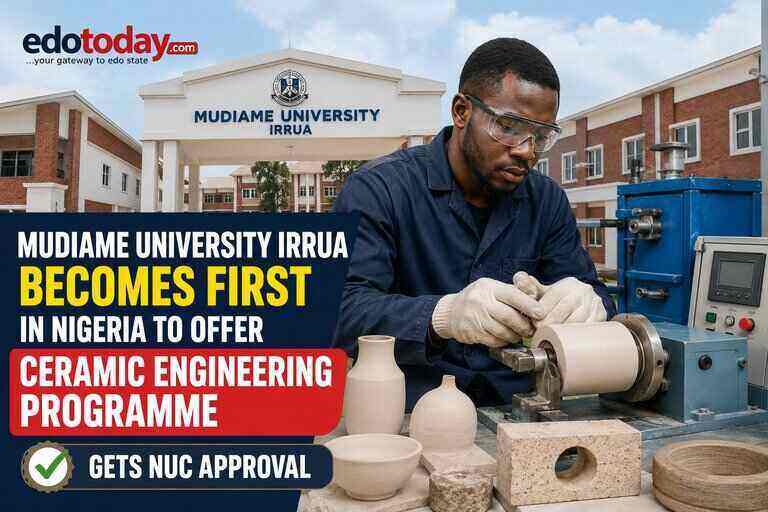
Mudiame University, Irrua, has become the first university in Nigeria to receive approval from the National Universities Commission (NUC) to offer a Bachelor’s degree in Ceramic Engineering, a landmark development expected to expand specialised engineering education and support the country’s growing industrial sector.
The announcement was made by the Vice Chancellor of Mudiame University, Professor Emmanuel Aluyor, during an interview on NTA International’s special programme, “Beyond Certificate: Nigeria’s Quest for Employable Graduates,” aired as part of the network’s 2 p.m. News on Tuesday, July 21, 2026.
Speaking on curriculum reforms and graduate employability, Professor Aluyor said the approval represents a significant step towards producing engineers with specialised expertise capable of meeting the needs of Nigeria’s manufacturing and industrial sectors.
“The NUC has given Mudiame University approval to run Ceramic Engineering. That will probably be the first university in Nigeria that will be running a Ceramic Engineering curriculum,” he said.
The Vice Chancellor explained that the programme is part of a broader effort to make university education more responsive to emerging industry demands by introducing specialised courses that prepare graduates for clearly defined areas of professional practice.
Moving Beyond Broad-Based Engineering Education
Professor Aluyor noted that engineering education in Nigeria has traditionally focused on producing graduates with broad technical knowledge across several disciplines.
Using Materials Engineering as an example, he explained that students are introduced to different classes of engineering materials during their training, giving them a wide understanding of the field.
Ceramic Engineering, however, adopts a different approach.
Rather than covering multiple material categories, the programme focuses specifically on ceramic materials, their properties, manufacturing processes and industrial applications.
According to Professor Aluyor, this level of specialisation allows students to develop deeper technical competence in an area that continues to gain importance within modern manufacturing and engineering.
He said specialised programmes such as Ceramic Engineering reflect the growing need for universities to align academic offerings with technological advancement and industry requirements.
Supporting Nigeria’s Industrial Growth
Professor Aluyor linked the introduction of the programme to the broader conversation on Nigeria’s industrial development.
He argued that while universities have a responsibility to train competent graduates, industries also need professionals with specialised skills capable of driving innovation and improving productivity.
According to him, programmes like Ceramic Engineering can help build the skilled workforce required to support sectors such as ceramics manufacturing, building materials, advanced materials processing and industrial production.
He maintained that as Nigeria seeks to diversify its economy and strengthen local manufacturing, universities must continue to introduce academic programmes that respond to changing workforce demands.
Specialisation Must Be Matched by Industrial Expansion
While welcoming the NUC approval, Professor Aluyor cautioned that specialised academic programmes alone cannot address graduate unemployment.
He observed that universities can produce highly skilled graduates, but their expertise can only be fully utilised when industries capable of employing them exist.
According to him, expanding Nigeria’s industrial base should remain a national priority alongside ongoing reforms in higher education.
He argued that stronger collaboration between universities, industry and government would enable specialised programmes to achieve their intended impact by creating employment opportunities and encouraging innovation.
“The industries should be part of driving these reforms,” he said, adding that closer engagement between employers and universities would ensure graduates acquire skills that reflect real workplace needs.
Mudiame University Plans Additional Specialised Engineering Programmes
Professor Aluyor also disclosed that Mudiame University is seeking approval to introduce Welding Engineering, another specialised programme designed to deepen technical training in engineering.
He explained that although welding is taught within Mechanical Engineering, a dedicated degree programme would produce professionals with advanced expertise in welding technologies and industrial fabrication.
The proposed programme, he said, forms part of the university’s strategy to expand specialised engineering education while responding to the manpower needs of modern industries.
According to him, universities must continue to innovate by developing programmes that not only meet academic standards but also contribute directly to national development.
A Milestone for Engineering Education
The approval of Nigeria’s first Ceramic Engineering programme positions Mudiame University among the institutions driving innovation within the country’s higher education sector.
Beyond introducing a new academic programme, the development reflects a growing shift towards specialised training designed to equip graduates with industry-relevant expertise in emerging fields.
For Mudiame University, the milestone represents an opportunity to contribute to the development of a highly skilled engineering workforce, while supporting national efforts to strengthen industrial capacity, encourage technological innovation and prepare graduates for the future of work.
Get Real-time Edo State News, Job Alerts and Opportunities
Join our WhatsApp Channel for breaking news, job updates, scholarships, and opportunities in Edo State.
Join Our WhatsApp Channel →